"To Kill a Mockingbird" - Harper Lee, Aaron Sorkin - Huntington Theatre Company (Boston, MA.) - REVIEW
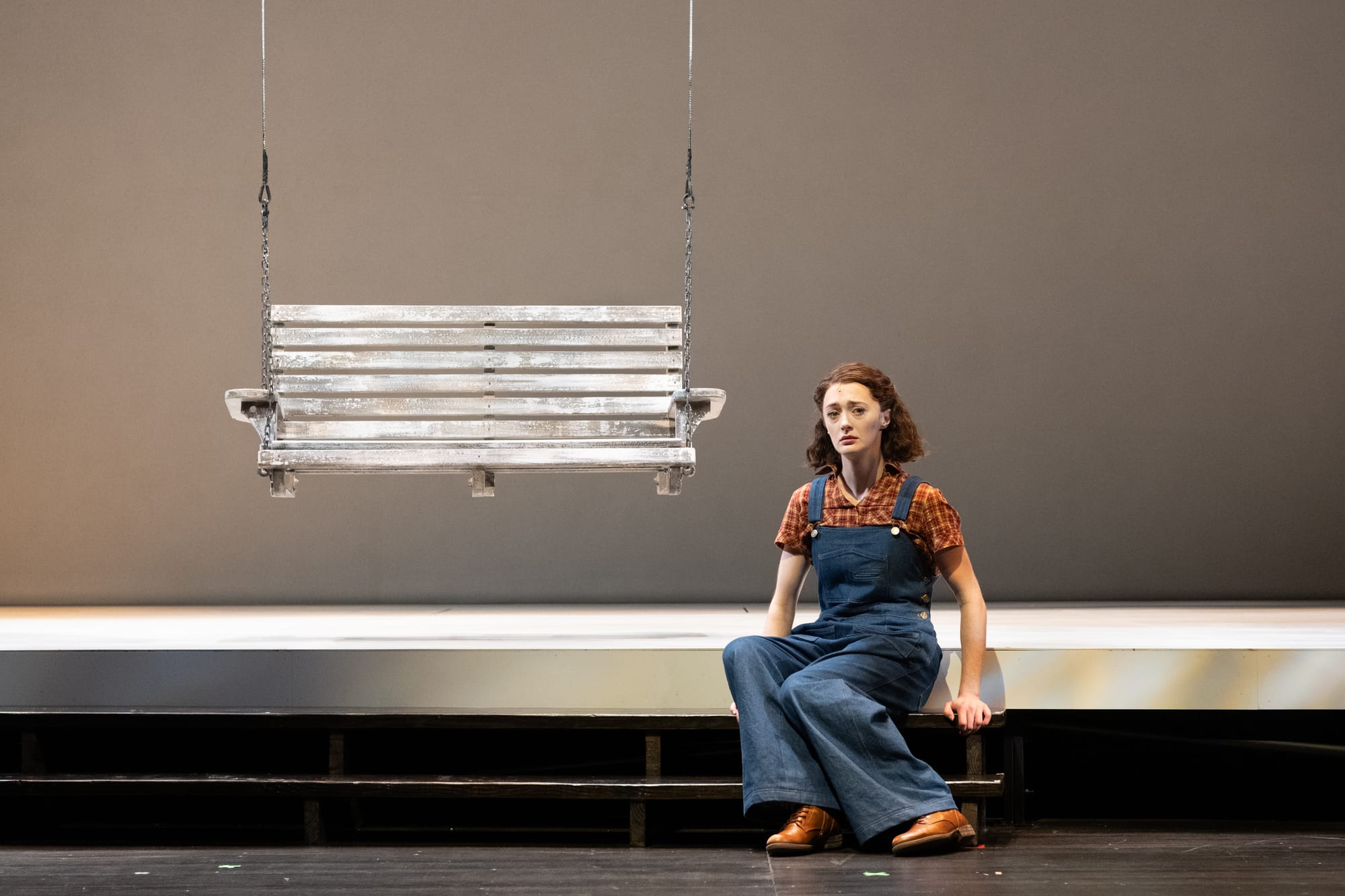
(Cover Photo: Karen Killeen as “Scout” in a scene from Harper Lee's "TO KILL A MOCKINGBIRD" as adapted by Aaron Sorkin, presented by Huntington Theatre Company at 264 Huntington Avenue, Boston, MA. through November 8, 2026. Photo Credit: Liza Voll)
By Kevin T. Baldwin
METRMAG Reviewer
# 774-242-6724
"It’s when you know you’re licked before you begin, but you begin anyway, and you see it through no matter what. You rarely win...but sometimes you do.”
- ("Atticus Finch") / Harper Lee

Huntington Theatre Company
Presents Aaron Sorkin's Adaptation of
Harper Lee's
"TO KILL A MOCKINGBIRD"
Adapted by Academy Award® winner Aaron Sorkin
Based on the Pulitzer Prize-winning book by Harper Lee
Directed by Huntington Artistic Director Loretta Greco
Cast Includes: Karen Killeen* as “Scout,” Benjamin Izaak as “Jem,” Andrew Stevens Purdy* as “Dill,” Rafael Jordan* as “Tom Robinson,” Jesse Garlick as “Horace Gilmer,” Michael Poignand* as “Sheriff Heck Tate,” Liam Craig* as “Bob Ewell,” Jackie Scholl as “Mayella Ewell,” Patrice Jean-Baptiste* as “Calpurnia,” Karl Kenzler* as “Atticus Finch,” Lewis D. Wheeler* as “Bailiff/Dr. Reynolds,” Ken Cheeseman* as “Judge Taylor,” Jesse Hinson* as “Mr. Cunningham/Boo Radley,” Aimee Doherty* as “Miss Stephanie/Dill’s Mother/Mrs. Dubose,” Kyle Cameron* as “Link Deas,” Ashley Frith as “Musician.”
Ensemble: Wyatt Anton, Liam Delaney, Bob Gallagher, Raissa Karim, Zach Kautter, James Milord*, Cameron Mysliwicz, Alex W. Pollock*, Scott Salley, Will Sheerin, Joanna Strapp*
Understudies: Jackie Scholl (Scout); Wyatt Anton (Jem; Dill); James Milord* (Tom Robinson); Zach Kautter (Horace Gilmer; Sheriff Heck Tate; Bailiff, Dr. Reynolds); Alex W. Pollock* (Bob Ewell; Judge Taylor; Mr Cunningham, Boo Radley; Link Deas); Joanna Strapp* (Mayella Ewell; Miss Stephanie, Dill's Mother, Mrs. Dubose); Raissa Karim (Calpurnia); Lewis D. Wheeler* (Atticus Finch).
Additional Creative Team:
Scenic Design - Andrew Boyce; Composition - Daniel Baker, Ashley Frith; Costume Design - Celeste Jennings; Lighting Design - Christopher Akerlind; Sound Design - Daniel Baker; Wig, Hair and Makeup Design - J Jared Janas, Cassie Williams; Dramaturg - Charles Haugland; Casting - Janet Foster; Stage Manager - Lauren J. Burke*, Kendyl Trott, Athéna-Genesis Baptiste; Producing Director - Kevin Schlagle; Local Casting - Brett Duffy; Production Stage Manager - Kevin Schlagle*.
*Indicates the actors and stage managers as members of Actors' Equity Association, the union of professional actors and stage managers in the United States.
Performances:
October 8, 2026 through November 8, 2026
(Contact Box Office for Exact Times)
The Huntington Theatre 264 Huntington Ave. Boston, MA 02115
TICKETS:
Available online at huntingtontheatre.org, by phone at 617-266-0800 or in person at THE HUNTINGTON THEATRE, 264 Huntington Avenue, Boston.
BUY TICKETS
COVID 19 PROTOCOLS
Contact Venue for Most Updated COVID-19 Safety Protocols and Information.
Huntington Theatre Company offers a visceral, riveting staging of Harper Lee’s quintessential novel "TO KILL A MOCKINGBIRD" now playing in Boston.
With a masterful new adaptation by Aaron Sorkin, the groundbreaking play explores prejudice based not only on the surface, notably the surface of one’s skin pigmentation, but also prejudice based on economic and social class.
This newer stage adaptation by Sorkin features ingenious staging by Huntington Theatre director Loretta Greco, expanding upon various aspects of the overall Lee story.
Using deceptively minimalistic staging, the set design is brilliant, with lights raised and lowered for precise, specialized illumination and set pieces raised and lowered as needed for various scenes.
In the blocking, Greco also makes use of the entire Huntington Theatre space with actors intermittently performing in the aisles or even up in balcony areas.
Whatever one's position - should they savor Sorkin's contributions and loathe Lee’s original story - or, instead, should they love Lee’s story and scorn Sorkin's contributions - "TO KILL A MOCKINGBIRD" is still considered the gold standard of American drama.
The Huntington Theatre Company production is also a substantially clever show with impeccable performances by its entire cast.
Despite dealing with serious issues of rape and racial inequality, Lee’s story is renowned for its warmth and humor, exemplified by the emotive performances by the cast.
"TO KILL A MOCKINGBIRD" was first published as a novel in 1960 by author Harper Lee.
An instant hit in America, it won the Pulitzer Prize for literature and, even after 60 years, continues to be widely read in many schools.
The plot and characters are loosely based on Lee’s observations of her family, her neighbors and an event that occurred near her hometown of Monroeville, Alabama, in 1936, when she was 10 years old.
Be it in the novel, the classic screen adaptation or in this latest stage adaptation, "TO KILL A MOCKINGBIRD" is, at its core, a coming-of-age story.
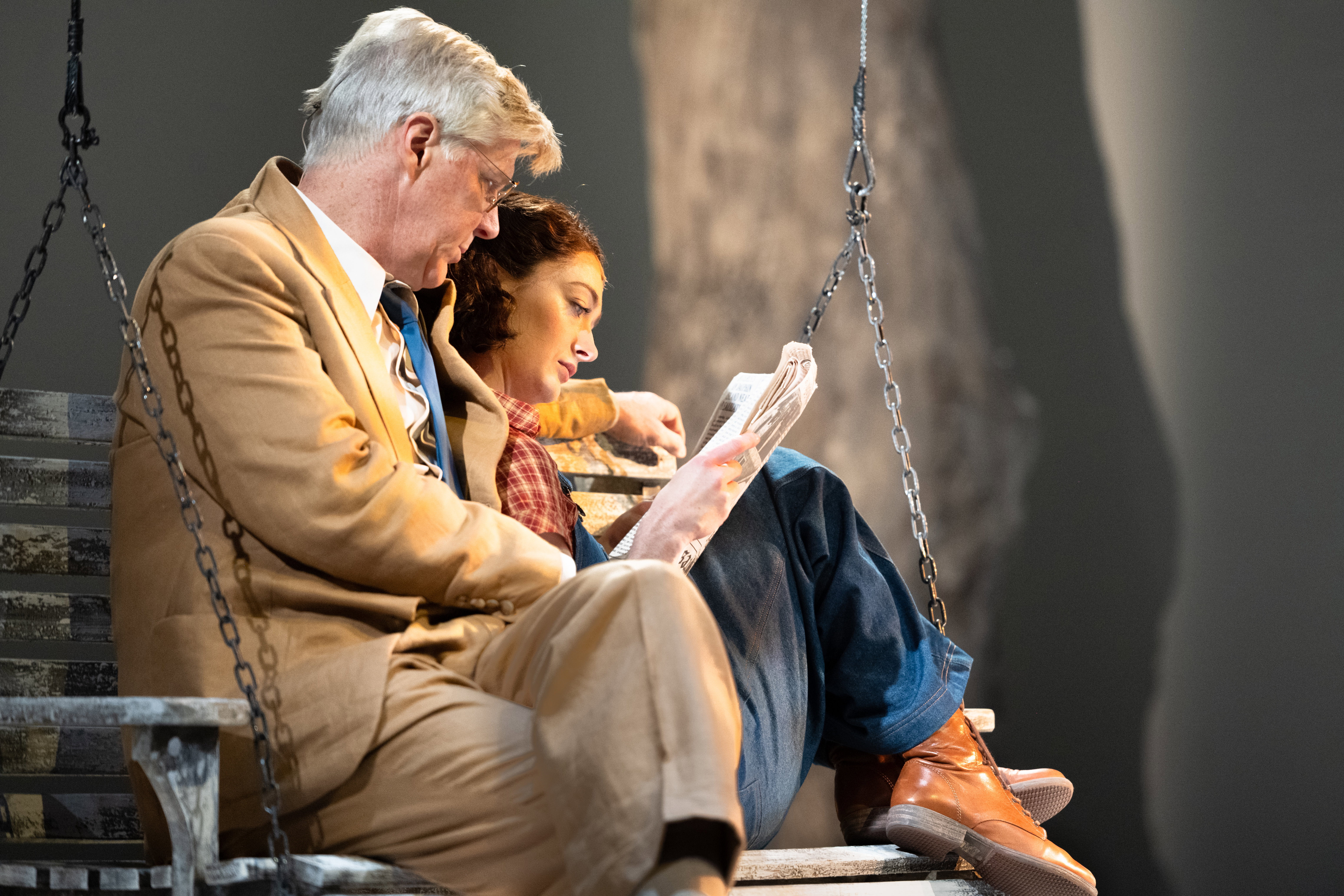
(Photo: Karl Kenzler as “Atticus Finch” sits with Karen Killeen as “Scout” in a scene from Harper Lee's "TO KILL A MOCKINGBIRD" as adapted by Aaron Sorkin, presented by Huntington Theatre Company at 264 Huntington Avenue, Boston, MA. through November 8, 2026. Photo Credit: Liza Voll)
We are in Maycomb, Alabama during the 1930s between the Great Depression and Jim Crow era.
The Great Depression is reflected in the poverty shared by all the residents of this small Maycomb community.
Attorney Atticus Finch (Karl Kenzler) is a widower with two children.
The character of Atticus has served as a moral compass and template for many fictional heroes that came after, also representing a model of integrity for attorneys at law.
In the Sorkin adaptation, the character of Atticus is far less elevated, shown more clearly as flawed, a product of his time and also a product of the place in which this story exists.
Calpurnia (Patrice Jean-Baptiste) is the steadfast, loyal maid and housekeeper who runs an organized house for Atticus, also reminding him of certain realities in the process.
In the classic 1962 movie adaptation of "TO KILL A MOCKINGBIRD" there was an emphasis made to depict a more employer-employee relationship between Atticus and Calpurnia as the latter character was not as developed.
In the stage adaptation by Sorkin as staged for Huntington Theatre Company by Greco, the story expands upon the Calpurnia character, making her more a “sibling” relationship with Atticus, especially when it comes to the raising of the children, in particular, Scout.
There is an emphasis here on a far more significant partnership.
“Atticus Finch” is also far from the “moral compass” as originally played by Gregory Peck.
That aspect has been largely shifted to Calpurnia.
Jean-Baptiste gives an unrelenting, energetic portrayal of Calpurnia, fiercely devoted to the Finch family.
Calpurnia is spiritual guide, role-model and teacher to both Jem (Benjamin Izaak) and Scout (Karen Killeen), Atticus’s children...and then becomes a much-needed teacher to Atticus, as well.
Calpurnia is educated, persistent and stringent but also compassionate and nurturing.
She holds Atticus accountable when he needs to be reminded of his responsibilities...as a father, as a lawyer and ultimately as a good man.
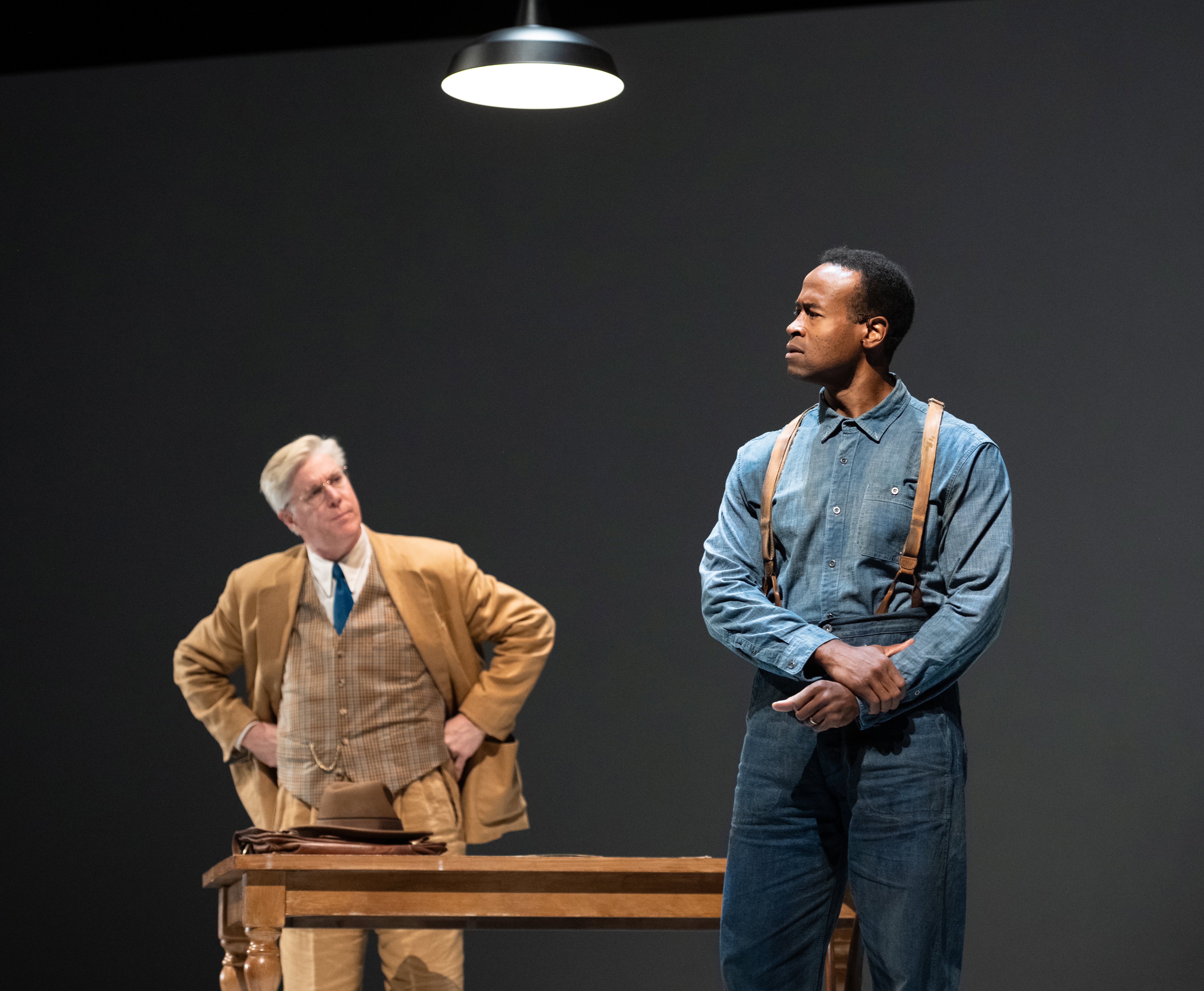
(Photo: Karl Kenzler as “Atticus Finch” with Rafael Jordan as “Tom Robinson” in a scene from Harper Lee's "TO KILL A MOCKINGBIRD" as adapted by Aaron Sorkin, presented by Huntington Theatre Company at 264 Huntington Avenue, Boston, MA. through November 8, 2026. Photo Credit: Liza Voll)
It is actually the trio of young girl Scout, her brother Jem and their friend Dill Harris (Andrew Stevens Purdy) who convey the narrative of the play.
The children call their father by his first name after observing how others addressed him.
In the original story, Jem started calling her father “Atticus” as a toddler, and Scout simply followed his lead.
"TO KILL A MOCKINGBIRD" depicts how Scout and Jem each come to gain a better understanding of the world as it truly exists around them.
Showcasing an unbreakable bond, actors Izaak, Killeen and Purdy together provide a dominating, cohesive narrative throughout the two-act drama.
Izaak as Jem give a fine rendering of a boy becoming a young man, yet is not being recognized by his own father for that man he is becoming.
Purdy is delightful as Dill, supplying many of the show's biggest - and much needed - laughs.
The clever approach to having them share in the narration is a fascinating highlight of this staging by director Greco while also using the sophisticated construct of the show's set to allow for fluid scene changes.
As part of the Finch family's collective journey, there are many associated themes in "TO KILL A MOCKINGBIRD," that include (but are not limited to): prejudice, intolerance, class hierarchy, integrity, justice, innocence and your basic conflict of “good versus evil."
The family learns that there are not always "good people on both sides."
By the end of watching this play, should you not recognize the relevancy that still exists for the above, then you haven't quite been paying attention.
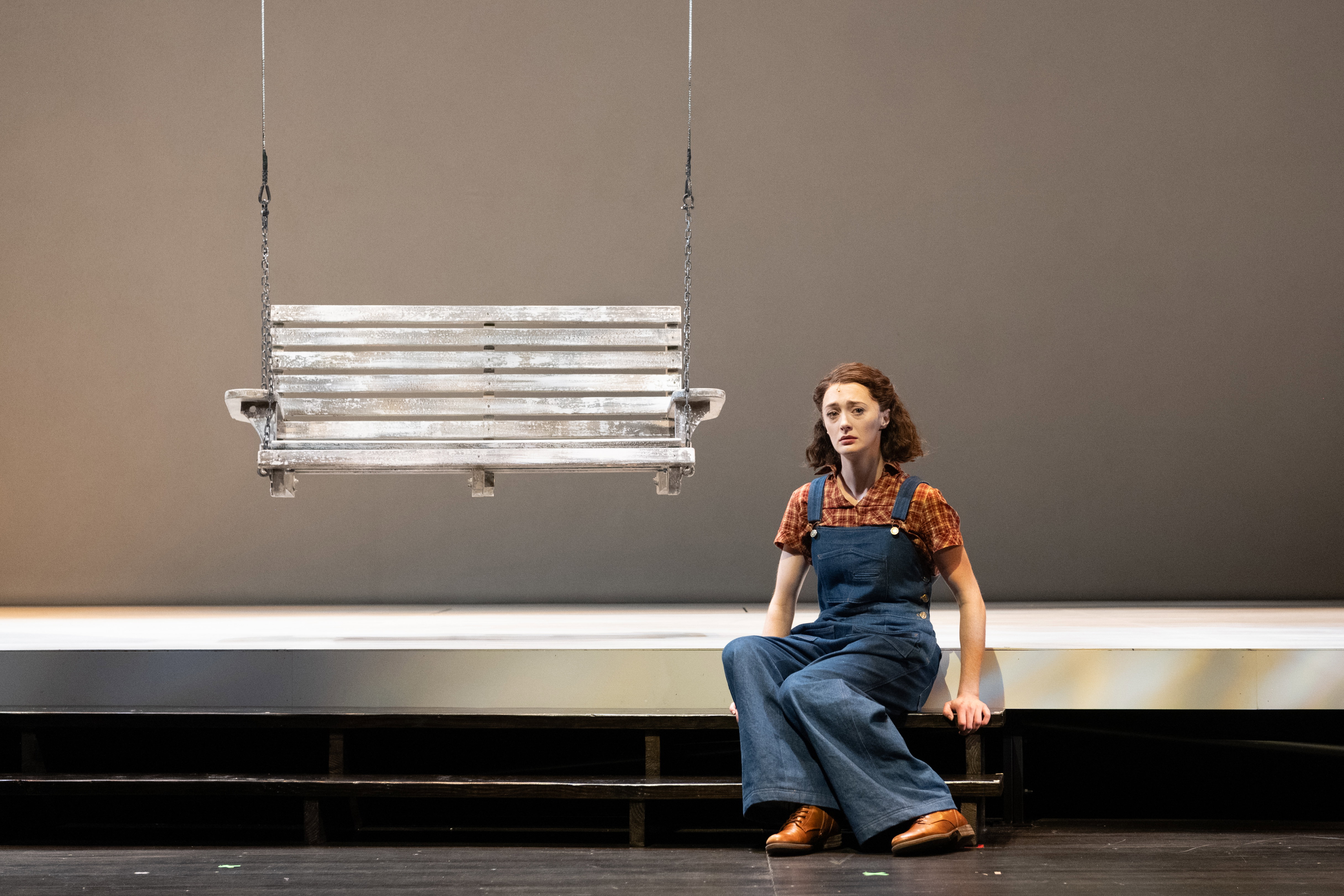
(Photo: Karen Killeen as “Scout” in a scene from Harper Lee's "TO KILL A MOCKINGBIRD" as adapted by Aaron Sorkin, presented by Huntington Theatre Company at 264 Huntington Avenue, Boston, MA. through November 8, 2026. Photo Credit: Liza Voll)
Scout and Jem are taunted by their peers for the mere fact that Atticus is charged with the unenviable task of defending a Black man charged with the vicious rape of a white girl.
Atticus only takes on the trial as a gesture to Judge Taylor (Ken Cheeseman) who feels Atticus is the only man who can give Robinson the kind of defense he deserves.
Cheeseman, as the Judge, has been gifted by the author many clever exchanges on stage, yielding some big laughs in the process.
The Finch siblings are at the age when children begin to see adults – even parents - as the flawed, imperfect and equally vulnerable creatures they are.
They begin to see their father as fallible - less of a hero and more as a man - and must consider if they can come to accept him as imperfect…as human…as he is.
While imperfect, he is still a damn sight better than others we meet as the story unfolds in "TO KILL A MOCKINGBIRD."
The racist Mrs. Henry Dubose (Aimee Doherty, who also portrays Miss Stephanie and Dill’s Mother) is a terminally ill, morphine-addicted elderly woman living near the Finch family.
Doherty gives a versatile rendering of Dubose and her other characters.
While berating Atticus for agreeing to defend a Black man for such a heinous crime, Atticus sees in Dubose's own latent struggle a stark parallel to the morality struggle he faces in his fight to vindicate unjustly accused Tom Robinson (Rafael Jordan).
Jordan is compelling as Robinson, a decent man, a family man, a moral man who showed compassion and kindness to a fellow struggling family, the Ewells, which was deserving of neither.
Evil incarnate Bob Ewell (Liam Craig) deflects his own crimes onto innocent Black man Robinson whose only crime was helping Bob's daughter, Mayella (Jackie Scholl) with some chores.
(Note: If you are offended by the "N word" you should be aware that it is used quite often in the Huntington Theatre Company production, among other racial slurs. Please keep this in mind also before attending with any young children or those easily triggered or offended by this usage.)
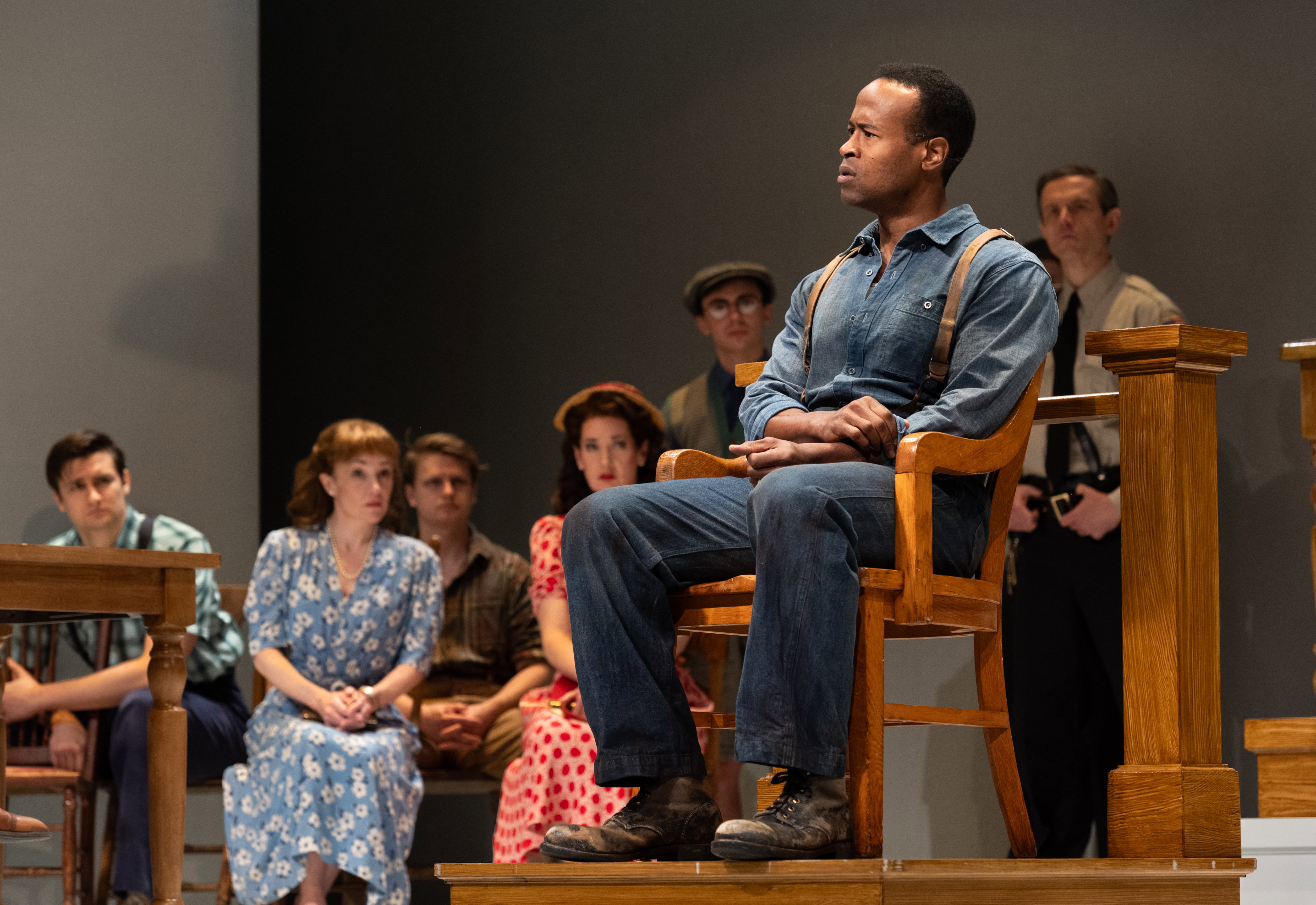
(Photo: Rafael Jordan as “Tom Robinson” in a scene from Harper Lee's "TO KILL A MOCKINGBIRD" as adapted by Aaron Sorkin, presented by Huntington Theatre Company at 264 Huntington Avenue, Boston, MA. through November 8, 2026. Photo Credit: Liza Voll)
Robinson, accused of raping Mayella, is jailed, convicted, and now stands trial for which, if found guilty, he will be executed in the electric chair for his crime.
The Ewells are a poor white family, ostracized by society with Bob Ewell suspected of abusing Mayella and her siblings.
Craig presents a defensively racist Ewell as does Scholl as Mayella, in two separate but equally effective performances.
Each character in the Ewell family brings forth their legacy of racial hatred and ignorance that they seem to want to wear as a badge of honor.
This is also a legacy shared by many in this small community, especially those on the jury for this trial.
By the way, none of the above are "spoilers" as there is no courtroom mystery here.
This is not a "who dunnit?" although there is a subplot mystery about the character "Boo Radley" (Jesse Hinson, who also portrays struggling farmer "Mr. Cunningham") which is only explored briefly.
No, the suspense in Sorkin's adaptation of "TO KILL A MOCKINGBIRD" instead comes from wondering how (and why) the unseen jury will ultimately vote for Robinson by the end of the trial.
If we are to consider what justice is supposed to be, if it cannot come from the letter of the law nor from our own legal system, where does one look to find it?
Using the optics granted to us as a society by using today’s more modern “lens,” one might also see prejudice based upon gender expectations.
This is best represented in the sensitive portrayal of Scout by Killeen as we observe Scout’s own personal exploration in trying to understand her own sense of femininity.
Killeen also dominates much of the narrative in the story in a thoughtful, sensitive performance.
There are also some wonderfully insightful exchanges between Dill, Jem and Atticus thanks to the genuine chemistry conveyed between respective actors Purdy, Izaak and Kenzler.

(Photo: Members of the CAST of Harper Lee's "TO KILL A MOCKINGBIRD" as adapted by Aaron Sorkin, presented by Huntington Theatre Company at 264 Huntington Avenue, Boston, MA. through November 8, 2026. Photo Credit: Liza Voll)
Sorkin's brilliant storytelling structure and sense of balance ensures no subplot ever distracts from the main story.
In the disciplined performance by Kenzler, Atticus shows he is not perfect but, as if on a mission, strives to be a person of integrity and to live his life according to what he feels is right.
The struggle for Atticus is in trying to instill the above in his children, as well, in a community that is not always "accommodating" to his mission.
"TO KILL A MOCKINGBIRD" is widely regarded as a literary turning point focused on the subject of racism and racist hierarchy in America, and "Atticus Finch," especially as humanized by Kenzler, is still most representative of someone who believes in an allegiance to justice, not bias.
In Robinson's defense, Atticus asks everyone in the courtroom (and in the audience) to consider just what the concepts of guilt, innocence, and good versus evil truly are – not just in Robinson’s case but for each and every one of us.
The above question is also what both Lee and Sorkin demand we ask of ourselves.
Not just today but every day.
Aaron Sorkin's adaptation of Harper Lee's "TO KILL A MOCKINGBIRD" continues at Huntington Theatre Company until November 8th, 2026 at the 264 Huntington Avenue location in Boston, MA. and it is still a tale worth raven about.
Next up as part of the 2026-2027 season at Huntington Theatre Company will be "ADIA AND CLORA SNATCH JOY" by Mfoniso Udofia and Michael Ellis Ingram beginning November 24th and running through December 13th, 2026.
For tickets and more information, contact Huntington Theatre Company online at huntingtontheatre.org, by phone at # 617-266-0800 or in person at Huntington Theatre Company, 264 Huntington Avenue, Boston.
BUY TICKETS
Approximately two hours, 45 minutes with one intermission.
Kevin T. Baldwin is a member of the American Theatre Critics Association (ATCA)
@MetrmagReviews
@Theatre_Critics

ABOUT THE SHOW
Harper Lee’s enduring classic "TO KILL A MOCKINGBIRD" is adapted anew as Aaron Sorkin, the brilliant and beautifully idealistic creator of "The West Wing" and "A Few Good Men," returns to writing for the stage.
When upstanding lawyer Atticus Finch seeks justice for a wrongfully accused man, he is tested by the limits of his virtue and the uneasy work of forgiveness in a world ruptured in two.
Harper Lee’s Pulitzer Prize–winning novel has resonated powerfully for over six decades.
What does it mean to revisit this beloved classic today with fresh eyes - to consider how far we’ve come, and how far we still need to go?
Artistic Director Loretta Greco creates the first regional production of Sorkin’s soaring adaptation of "TO KILL A MOCKINGBIRD," especially for Boston.

ABOUT THE HUNTINGTON THEATRE COMPANY
THE HUNTINGTON THEATRE COMPANY is Boston’s leading professional theatre and one of the region’s premier cultural assets since its founding in 1982. Recipient of the 2013 Regional Theatre Tony Award, THE HUNTINGTON brings together superb local and national talent and produces a mix of groundbreaking new works and classics made current to create award-winning productions. THE HUNTINGTON runs nationally renowned programs in education and new play development and serves the local theatre community through its operation of the Calderwood Pavilion at the BCA. THE HUNTINGTON has long been an anchor cultural institution of Huntington Avenue, the Avenue of the Arts, and will remain so on a permanent basis with plans to convert the Huntington Avenue Theatre into a first-rate, modern venue with expanded services to audiences, artists, and the community. THE HUNTINGTON cultivates, celebrates, and champions theatre as an art form.